Escaramuzas: the rigor and danger of Mexican side-saddle riding
For decades, escaramuzas have ridden the razor edge between grace and danger. These all-women teams perform synchronized maneuvers sidesaddle, in a spectacle born of Mexican charrería and fierce discipline.
🚀 Key Takeaways
- Core concept : Escaramuzas are women riding sidesaddle (amazone) in choreographed charro routines.
- Practical tip : Training starts on the ground then longeing, use protective vests and progressive exposure to pace and crowds.
- Did you know : The Federación Mexicana de Charrería was founded in 1933, giving structure to many charro and escaramuza traditions.
They move as one.
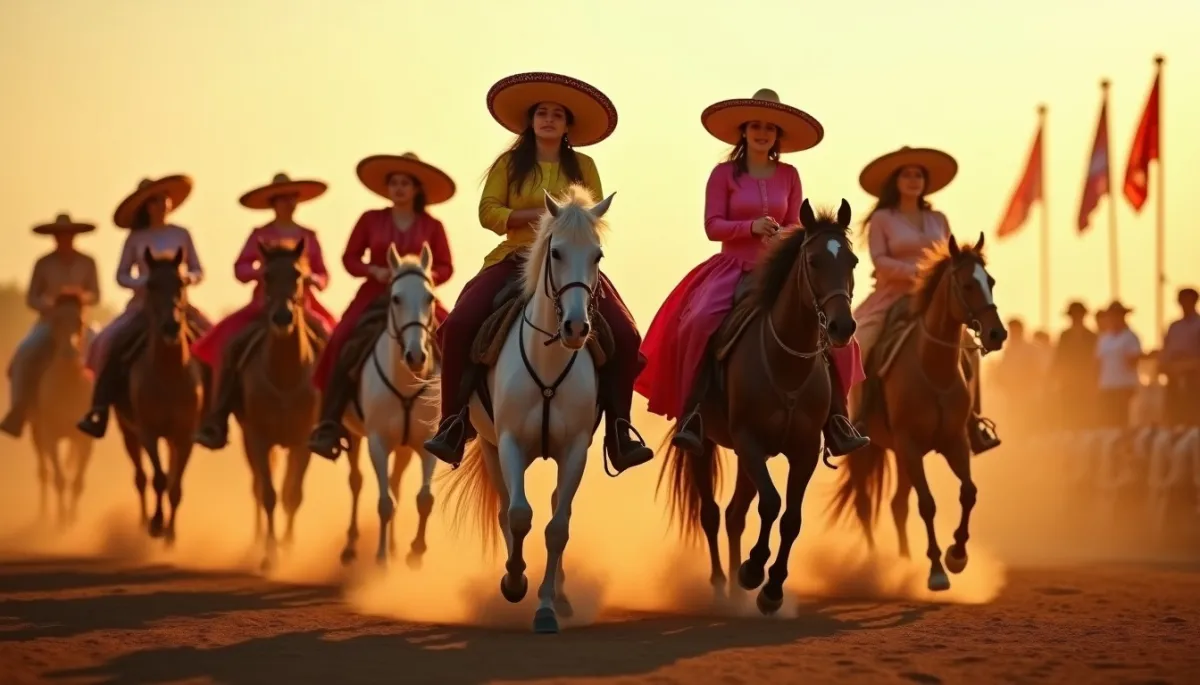
Imagine a dusty lienzo charro at dusk, flags snapping, and a row of ten women in colorful trajes de china poblana sliding into a perfect formation, each horse responding to the faintest signal, each rider balanced on a narrow seat with both legs on one side. The crowd holds its breath as the team executes a passage, a pivot, a gallop, all without the visible security of an astride rider.
Corps en mouvement
Escaramuzas are the female face of charrería, Mexico’s equestrian tradition. Teams of between eight and sixteen riders perform routines set to music. The core of their performance is the monte en amazone, or sidesaddle riding, where balance and timing replace the typical stirrup-driven support.
Their costumes are part of the show. The traje de escaramuza mixes function and symbolism: wide skirts that create visual waves, but also a challenge, because fabric must be managed while mounting, dismounting and controlling the horse. This aesthetic was shaped over the 20th century as women asserted a visible role in charro arenas.
These teams come from every part of Mexico, notably Jalisco, Chihuahua, Sinaloa, Zacatecas and Mexico City. They compete at regional fairs and at the Campeonato Nacional Charro, where precision and difficulty are scored by judges. The spectacle is traditional yet athletic.
Rites et risques
Riding sidesaddle multiplies physical demands. Without the symmetrical support of two legs, riders rely on core strength, a strong thigh hooking the pommel, and constant micro-adjustments. A stumble, a spooked horse, or a mis-timed maneuver can throw a rider off balance.
Accidents in charreadas are not unheard of. Horses bolting in tight formations, collisions between mounts, and falls are the main risks. In the 21st century organizers increasingly emphasize safety: controlled warm-ups, medical teams on site, and training protocols that simulate crowd noise.
Despite danger, the discipline attracts women of all ages. Some start as children in family haciendas, others join through riding schools. Anecdotes circulate about riders who mastered the longe line for weeks before attempting a trot sidesaddle. That patience is part of the escaramuza ethic.
Origines et ascension
The Federación Mexicana de Charrería, created in 1933, helped institutionalize many charro practices. Women’s formal participation took shape across the mid-20th century, when social changes and local clubs provided spaces for female riders to organize. By the 1950s and 1960s, regional teams were a common feature of fairs and rodeos.
The name escaramuza itself means skirmish, a nod to both feminine strength and historical references to soldaderas (female soldiers) such as the Adelitas of the Mexican Revolution (1910s). This cultural continuity gives the performances a layered meaning: pageant, sport, and living memory.
Modern escaramuza teams balance tradition and athleticism. Choreographies are devised to highlight formations like the flower, the serpent, and the gallop line. Judges reward difficulty, harmony, and the ability to control a horse at speed while maintaining costume and posture.
Contraints contemporaines
Tension exists between heritage and safety. Traditional aesthetics discourage helmets, favoring wide-brimmed sombreros and ornate hair and jewelry. Yet the push for protective equipment in practice sessions grows stronger, especially for younger riders. Some clubs allow helmets hidden under hats during practice, preserving spectacle while mitigating risk.
Another contradiction is access. Horsekeeping is expensive. Many promising riders stop because of costs for tack, horses and travel. Community-based manades and riding schools, similar to Camargue manades in Provence where mounted traditions support local identity, offer a model: collective care of stock to lower individual costs.
Finally, international attention brings both funding and pressure. Television and social networks amplify the beauty of performances, but also increase expectations for ever-more daring maneuvers, which raises safety questions. Responsible teams resist escalation, prioritizing technique and harmony over sensationalism.
Conseils pratiques
If you are curious to try or to support escaramuzas, start with lessons on balance and core strength. Trainers recommend beginning at the walk, progressing to longe work, then to paired rides before full formations.
Respect the costume’s function. Practice mounting and dismounting with the skirt, and learn to handle the sidesaddle pommel. Use protective vests and consider helmets during training. For spectators, appreciate the skill and refrain from sudden noises near the lienzo.
For readers from the Camargue, note the shared values: respect for the horse, community traditions, and staged horsemanship that binds people to landscape. Escaramuzas are a Mexican echo of regional mounted cultures, with their own risks and their own beauty.
Escaramuzas are more than a spectacle. They are a testament to discipline, historical memory and the daring that comes with riding sidesaddle. Watching them is to witness a conversation between woman, horse and tradition, held at full gallop.