The Camargue Cross decoded: symbol of faith, hope and charity
The Camargue Cross is more than a motif, it is a compact story of a land. Rooted in the marshes, it carries faith, hope and charity across generations.
🚀 Key Takeaways
- Key concept : The Camargue Cross combines a Christian cross, an anchor and a heart to symbolize faith, hope and charity.
- Practical tip : See it during the Saintes‑Maries‑de‑la‑Mer pilgrimage (May 24–25) or at the Musée de la Camargue in Arles.
- Did you know : The emblem grew in the early 20th century alongside the revival of Camargue traditions led by figures like Folco de Baroncelli‑Javon.
So simple, so telling.
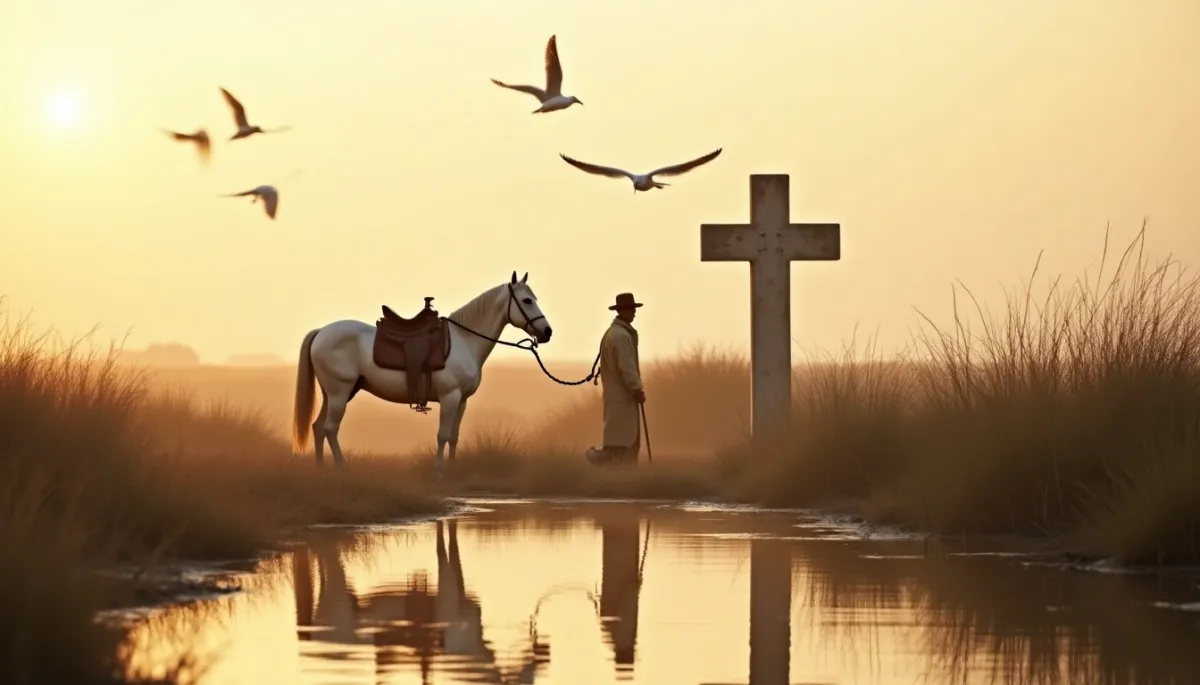
Imagine a white horse standing ankle‑deep in brackish water at dawn, a gardian (Camargue cowboy) adjusting his camisa, and the slender silhouette of a wrought‑iron cross on the stable wall, catching the first light. The salty air smells of reeds and hay; gulls wheel above the lagoons. That cross, repeated on saddles, flags and jewelry, is a shorthand for an entire world.
cross, anchor, heart
The Camargue Cross is composed of three elements: a Christian cross, an anchor and a heart. Each element is a sign (a simple symbol that carries a dense meaning): the cross for faith, the anchor for hope, the heart for charity (love for others).
This triad is not a modern marketing logo. It crystallizes values that the land imposes: faith against tempest and isolation, hope in the face of marshes and tides, charity toward neighbours, animals and guests. You will see the motif on manades (herds), on the collars of gardians' shirts, and engraved on simple iron crosses that dot cemeteries and mas (farms).
Photographs from the early 20th century show gardians and local notables posing with similar emblems. The symbol became widespread as local identity consolidated in the 1900s, when Camargue traditions were being codified and celebrated.
racines vivantes
The Camargue Cross emerged as part of a broader cultural revival. After decades of industrial change and tourism growth, local activists and criers of tradition sought visual signs that would represent the region. Figures such as Folco de Baroncelli‑Javon (1869–1943), who founded the Nacioun Gardiano in 1909, played a role in staging and protecting local customs, from the course camarguaise to bull breeding.
Although the exact designer of the cross is debated, its diffusion picked up in the 1920s and 1930s, when handcrafted ironwork and local emblems became popular. Blacksmiths in Arles and Saintes‑Maries‑de‑la‑Mer forged crosses that were both devotional and emblematic of the gardian way of life.
The cross also resonated with the Roma pilgrimage to Saintes‑Maries‑de‑la‑Mer, celebrated each year around May 24–25 for the feast of the saintes Maries and Saint Sara. During these days, processions, horses and boats merge sacred rites and popular festivity, and the Camargue Cross becomes a ubiquitous banner of belonging.
rituels et usages
In practice, the symbol functions on several registers. It is religious for churchgoers; cultural for the gardians and manadiers (herd owners); and commercial for souvenir shops and fashion. Jewelry makers cast small Camargue crosses in silver for tourists; local stables display large forged versions at their gates.
At the Musée de la Camargue in Arles and during heritage events, curators explain how the cross summarizes local ethics: respect for animals, a code of courage, and hospitality. The cross’s anchor evokes the sea and the marshes, anchoring hope to a landscape that is at once generous and unforgiving.
For visitors, a practical suggestion is to attend a matinée at a manade, speak with a manadier, and ask about the provenance of their cross. Many families keep records and photographs that trace the emblem through generations.
tensions et évolutions
Symbols evolve, and the Camargue Cross is no exception. With mass tourism from the 1960s onward, the motif spread far beyond its original community. That diffusion brought visibility but also debates about authenticity and commodification.
Some critics argue that the cross is sometimes reduced to a souvenir, stripped of context when sold on keychains or mass‑produced medals. Others welcome the symbol’s democratization, seeing it as a gateway for visitors to discover deeper stories about the land and its people.
Contemporary Camargue also faces environmental and social challenges: wetland management, salt extraction, and tensions between agricultural interests and protected area regulations. In this changing landscape, the cross remains a reminder of values to be negotiated: faith and tradition on one side, adaptation and inclusion on the other.
pour en savoir plus
If you want to go deeper, plan your visit in May for the Roma pilgrimage, or in summer to witness a course camarguaise. Stop at the Musée de la Camargue in Arles for archival photos. Talk to a gardian about his rosary or his iron cross; oral histories are full of small, human anecdotes that do the heavy lifting of history.
Remember that the Camargue Cross is at once a devotional object and a cultural seal. Treat it with curiosity and respect, and you will carry back a better story than a souvenir magnet: a story of people who shaped a symbol from salt, horsehair and faith.
Small advice: when buying local ironwork, prefer handcrafted pieces. They sustain local smiths and keep the dialogue between craft and memory alive.