Mole-skin trousers: why they're the Levi's jeans of the gardian
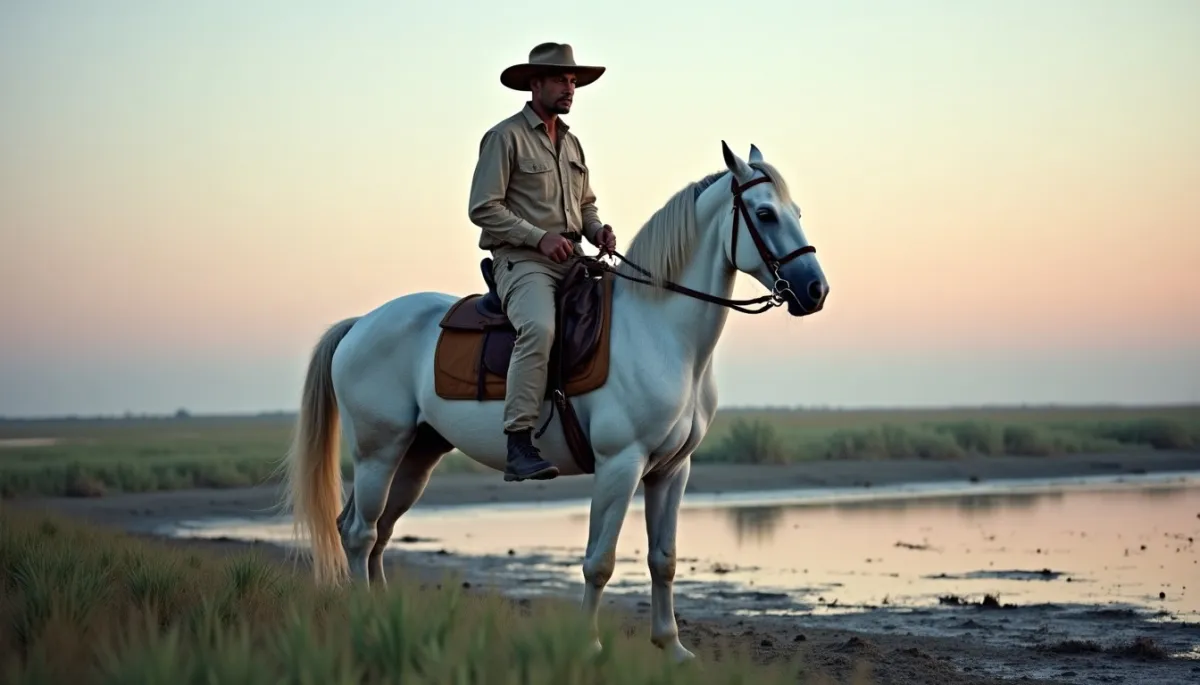
Mole-skin trousers have been at the heart of Camargue workwear for more than a century. Practical, emblematic and repaired rather than replaced, they are to the gardian what Levi's 501 is to the cowboy.
🚀 Key Takeaways
- Core concept : Durable suede trousers, widely adopted by gardians for riding and work.
- Practical tip : Clean with a soft brush, re-oil sparingly, never machine wash.
- Did you know : Levi's riveted jean was patented in 1873; the gardian look crystallised in the early 20th century.
A sight that stops you: a gardian stepping from his white Camargue horse, trousers dusted with marsh mud, hat tilted.
The scene is Saintes-Maries-de-la-Mer at dawn, the sky a low band of pink, a manade stirring. You hear the clink of tack, smell salt and leather. On the rider, the mole-skin trousers are worn at the knees, patched where the horse rubbed, shiny at the seat from years of saddle. They read like a life lived outdoors, practical and proud.
héritage et panache
These trousers are not a fashion whim. They belong to a working identity forged in the Camargue marshes. For the gardian, the garment signals belonging to a technique and a territory, as symbolic as the wide-brimmed hat or the bota (riding boots).
Historically, the garb of the gardian coalesced in the late 19th and early 20th centuries. Folco de Baroncelli (1869-1943), Camargue writer and defender of local customs, popularised a romantic image of the gardian. Photographs from the 1910s show men on horseback wearing sturdy, close-fitting leather or suede trousers adapted to the salt, reeds and rough work of manades.
Comparing them to Levi's is not extravagant. Levi Strauss and Jacob Davis patented the riveted jean in 1873, creating an icon of durability for American workers. In the Camargue, mole-skin trousers fulfil the same cultural and practical role, becoming the default for generations of gardians.
tannage et vie
What are they made of? The name evokes mole, but in practice the cloth is often a soft, heavily brushed leather or suede from calf or sheepskin, tanned to resist humidity while remaining supple. The surface holds grit and dries without cracking, important in a landscape of brine and mud.
Local artisans historically treated hides with vegetable tannins and oils, techniques that balance waterproofing and breathability. Garments were often handmade or adapted by family workshops. Repairs are part of the garment's soul: patches, reinforced knees, sometimes a hand-stitched seat. A pair can accompany a gardian for decades.
Practical care is simple but strict. Brush off saline mud when dry, use a soft brush for the nap, apply a light leather oil or dubbin in cool weather, avoid soaking and never a machine wash. Store away from damp, and let any wetting dry slowly at room temperature. These gestures prolong life and preserve the slow patina that tells a story.
entre tradition et renouveau
The trousers face modern tensions. Fashion occasionally borrows the silhouette, and tourists buy stylised versions. Some younger gardians choose modern waterproof technical trousers for wet days. Yet in many manades tradition holds: when a task asks for centuries of know-how, the old cut and material answer better than a new membrane.
There are also opportunities. Artisans in the Gard and in Arles collaborate with designers to produce contemporary pieces that keep traditional cuts and reinforce seams, while using modern tanning less harmful to the environment. These hybrids help the garment survive economically and ecologically.
In the end, the mole-skin trousers remain emblematic because they are earned. They are patched like an old saddle, chosen for function, and loved for the visible history on their surface. Like Levi's in the American West, they are a shorthand for a way of life: hands, horses, marshes, and the slow work of maintaining a craft.
If you want to try a pair: speak with a manadier at a manade open day in spring, observe how the trousers sit on the horse, and ask about local repair methods. Respect the garment as you would a history lesson.