The Nudie suit: rhinestones, sequins and country extravagance
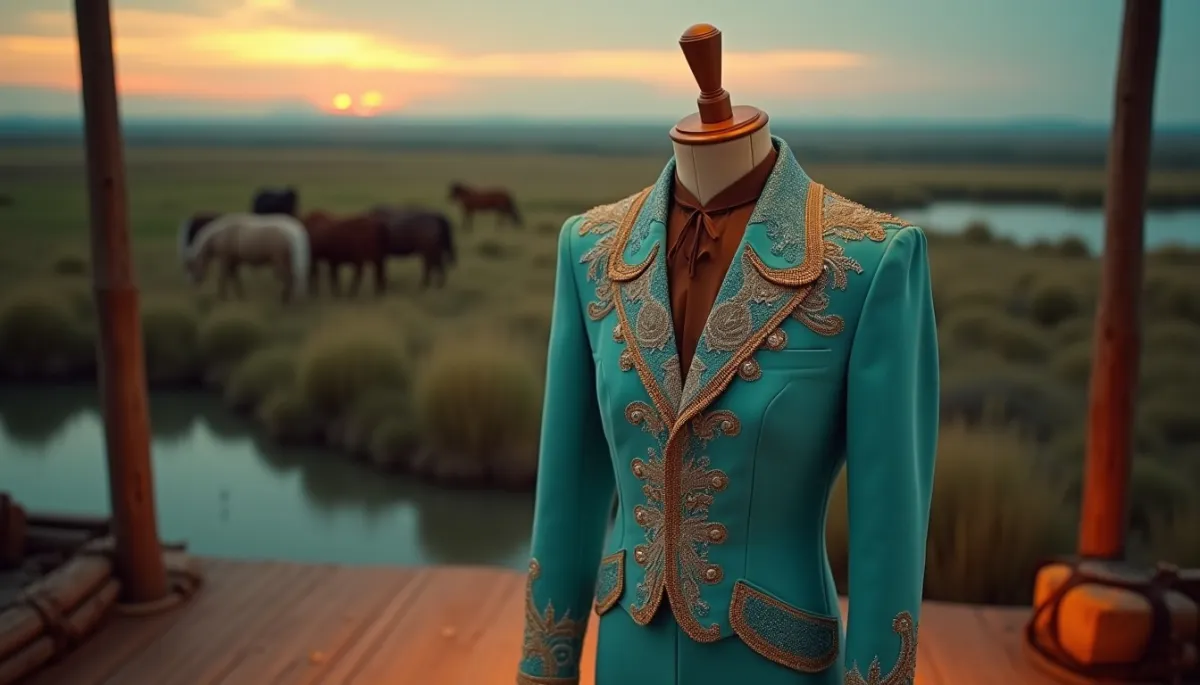
Nudie suits turned country music's humble stages into catwalks of sequins and spectacle. From 1947 Hollywood workshops to modern collectors' displays, their glitter tells a story of showmanship and identity.
🚀 Key Takeaways
- Key concept : The Nudie suit is a rhinestone-covered, embroidered stage suit popularized in postwar America.
- Practical tip : For authenticity, favor wool-blend bases, bold embroidery and hand-set rhinestones.
- Did you know : Original Nudie creations are displayed in institutions such as the Country Music Hall of Fame.
Glitter that tells a life story.
Picture a smoke-hazed honky-tonk in 1952, a single spotlight on a singer whose jacket catches the light like a constellation. The jacket is turquoise, the trousers have embroidered longhorns, and every move throws off a tiny explosion of rhinestones. That was Nudie Cohn's invitation: stagewear that transformed country performers into traveling legends, visible from the cheap seats to the VIP booth.
Flash and function
Nudie suits are not mere costumes. They are tailored narratives. Each piece combines cut, color and motifs that tell a performer's story: roses for heartbreak, eagles for pride, guitars for the trade. The aesthetic solidified in the late 1940s and 1950s as country shows migrated from small towns to radio, then television.
Nudie's Rodeo Tailors, established in the late 1940s in North Hollywood, became synonymous with the style. Nudie Cohn (1902-1984) and his shop created bespoke suits for stars who needed to read clearly at a distance. Porter Wagoner, Roy Rogers and later figures in the country-rock spectrum adopted the look to stand out on screen and stage.
Beyond glamour, the suits served a pragmatic purpose. Heavy wool blends and reinforced seams held up to touring. Hand-applied rhinestones and embroidered appliqués resisted the glare and wear of stage lights, while bold colors read well on early black-and-white television by contrast alone.
Stitched identities
Who wore them and why they mattered is a story of image-making. Porter Wagoner made the purple Nudie suit part of his television persona in the 1950s and 1960s. Gram Parsons embraced Nudie-style tailoring as a visual manifesto for his country-rock fusion in the late 1960s and early 1970s. These garments became signatures, shorthand for a performer's aesthetics and values.
Manuel Cuevas, a Mexican-born tailor who worked in the same Los Angeles circles, helped evolve the craft. He blended traditional tailoring with local savoir-faire, dressing figures across country and rock. The result was a cross-cultural workshop culture that mixed rhinestones, fringe and local iconography.
Today, original Nudie pieces are exhibited in museums, including the Country Music Hall of Fame. Collectors and stage designers prize these suits not only for their sparkle, but for their role in defining American musical identity after World War II.
From runway to ranch
The cause of the Nudie phenomenon lies in postwar mass media, changing fashion and a hunger for spectacle. Television demanded visuals that read at a distance. Touring artists needed a consistent, legible persona. Nudie offered both showmanship and craftsmanship, dressing performers for the new media age.
Economic factors played a role as well. The prosperity of the 1950s and the expansion of live entertainment budgets allowed stars to commission custom stagewear. Nudie's flamboyance matched the era's taste for abundance, while also nodding to older Western motifs like fringe and embroidery.
Finally, the suits fit a tradition of self-mythologizing in country music. Outfits became an extension of songs and stories, a visible layer of commentary. When a performer put on a Nudie suit, the costume amplified the tale they were telling onstage.
Glitter with tension
Despite the glamour, Nudie suits sparked debates. Purists accused the rhinestones of cheapening country authenticity. Others saw the suits as empowering, a way for artists to claim space and dramatize identity. This tension remains: is ornamentation theatrical excess, or a legitimate cultural language?
Contemporary designers and performers rework the style. Some keep the heavy embellishment, while others translate motifs into subtler embroidered pieces for modern stages. The legacy is therefore both continuous and adaptable, able to appear in a Nashville bar, a Camargue feria or an indie festival.
For those who want a touch of Nudie today, practical advice matters. Look for experienced tailors who hand-set rhinestones. Choose motifs meaningful to your story. And consider local accents: in the Camargue, tack on embroidered gardians, horses or bulls to root the suit in place and tradition.