Camargue wines and terroirs
Camargue wines breathe salt and sun. They tell the story of the encounter of a vine with the sea and the marshes.
🚀 The essentials
- Key concept: The Camargue terroir results from saline soils, the Mediterranean climate and human practices.
- Practical advice: Come in September during the harvest, combine a local rosé with gardiane or rice.
- Did you know: Roman history, phylloxera and recent organic conversions have shaped the vineyards.
Live, salty and often elegant: Camargue wines tell the story of the paradox of the delta.
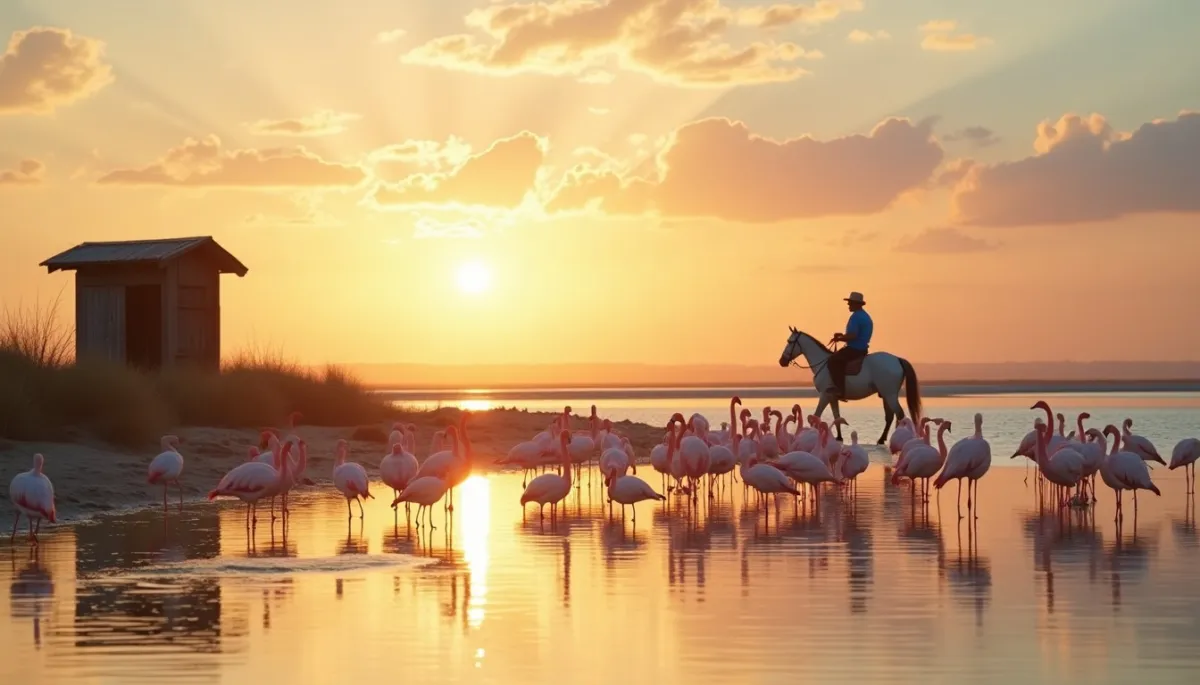
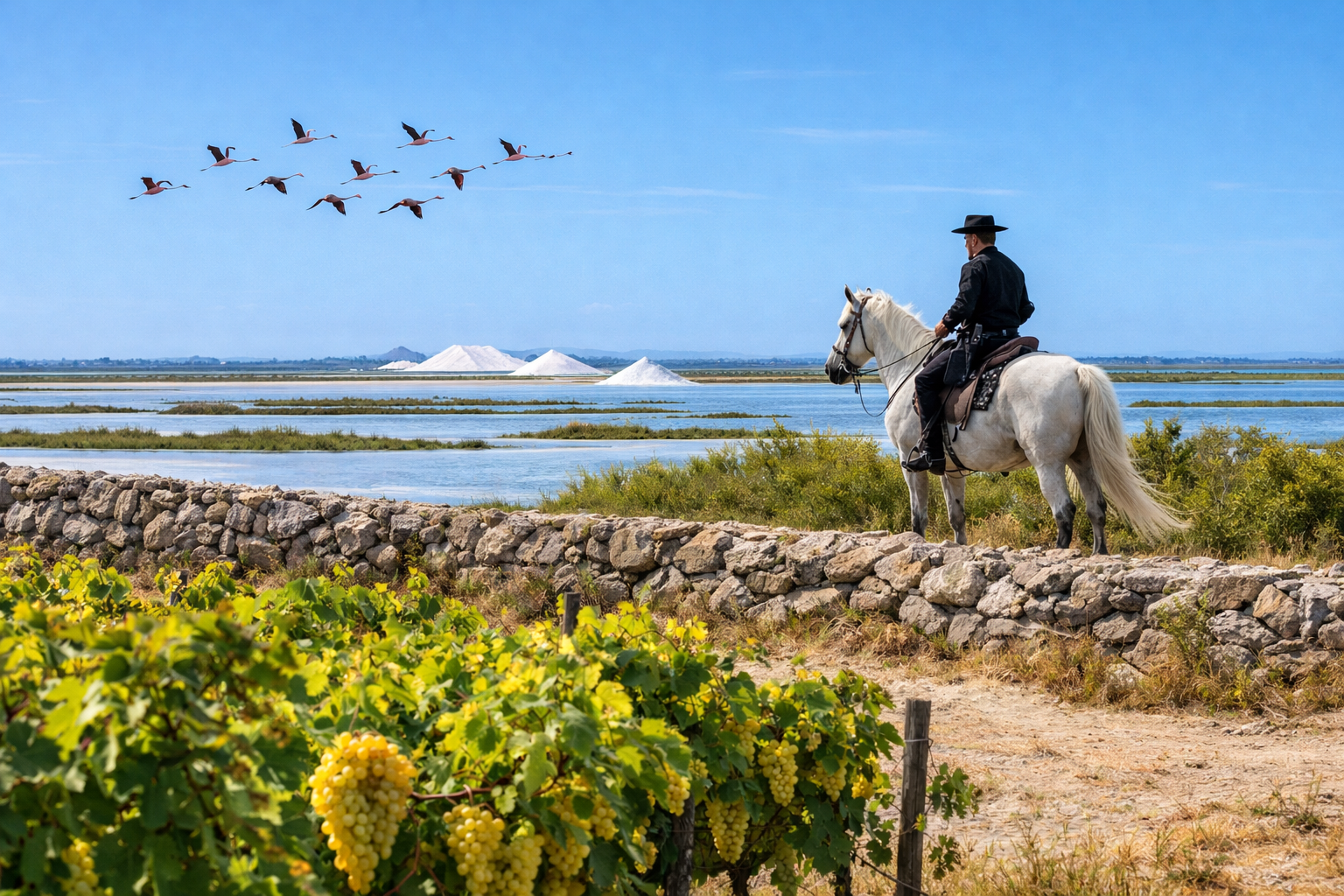
Imagine a low dike between a vineyard and a marsh at sunset. A herdsman passes by on horseback, his dark clothes silhouetted against the whiteness of the horses. On the horizon of the salt flats, flamingos punctuate the sky. The vines, sometimes swept by the mistral, carry clusters which reflect a golden light. The air smells of iodine, hay and a hint of salt; it is this land-sea duality that is immediately striking.
Everywhere, plots from the suburbs of Arles to the outskirts of Aigues-Mortes and Salin-de-Giraud produce wines that express this place: this is the introduction, the consequence.
Mars, vine and marsh
In the mouth, the wines evoke the territory. There are clear rosés, light reds carried by Grenache and Mourvèdre, whites that are fresh and saline rather than woody. The word “mineral” (saline or stony tendency perceived during tasting) often comes up among tasters.
The small cellars around Arles and along the coast install grape varieties and trellises adapted to the sea spray. In the farmhouses near Saintes-Maries-de-la-Mer, the winegrowers explain how they protect the grape clusters from the mistral by choosing low rootstocks and sheltered planting lines.
After a storm in the 1990s, several plots affected by saline intrusion produced more concentrated wines. Rather than abandon these lands, some producers have cultivated them into fine rosés. These tests are today recounted as local victories.
April, earth and memory
Why these choices? History and necessity. The Romans already planted vines on well-drained terraces. Phylloxera in the 19th century forced replanting on tolerant rootstocks, and local viticulture was modeled to coexist with rice, marshes and salt flats.
Local culture matters. Herdsmen, rice farmers and salt workers maintain a mosaic landscape, made up of fields, canals and hedges. This diversity creates microclimates. Many contemporary wine projects therefore rely on cooperation to manage water, reduce pesticides and develop organic farming in order to preserve the marsh ecosystem.
Markets and policies also encourage an increase in quality. The proximity of tourists to Arles or Aigues-Mortes and the growing recognition of the terroir (through local mentions or IGP) have enabled estates to modernize their cellars and invest in direct marketing.
May, doubts and horizons
However, there are contradictions. Salt can make wines more complex while reducing yields. Some producers are under pressure from low-margin bulk production. Urban expansion around Arles and port infrastructure threaten valuable land. Climate change increases the risks of salt intrusion and extreme events.
Yet opportunities also arise. Research on salt-tolerant rootstocks, the establishment of plant cover to retain humidity, and the use of various grape varieties are opening new avenues. Winegrowers are exploring blends of plots and light vinification to favor freshness and the identity of the place.
Practical advice for the visitor: favor small estates in September, ask what the micro-plot is and how the water is managed, taste the local agreements. A dry rosé with gardiane or a lively white with shellfish will reveal the culinary logic of the Camargue.
In short, the wines of the delta are a conversation between salt and earth, between ancient practices and modern ecology. They are not trying to imitate the American West. They are Camargue: a territory where the vines have learned to live with salt and where each bottle carries the memory of the wind and the birds.