Saddlery in the Camargue: a virtual meeting with the last leather masters
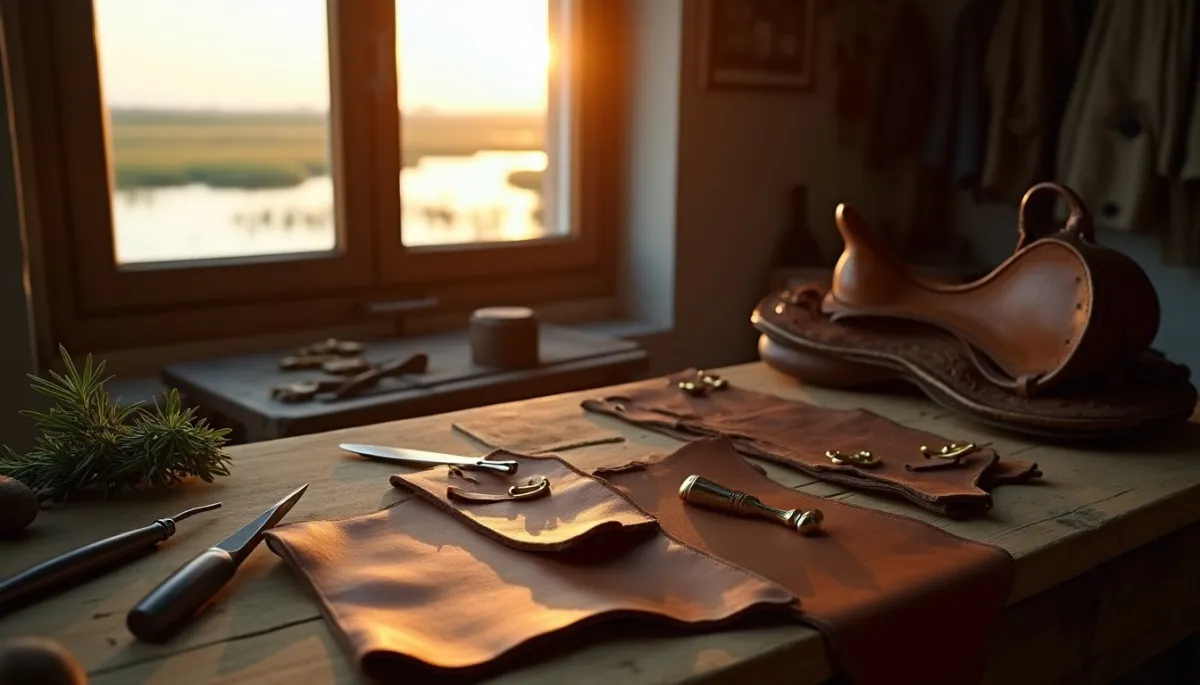
Two generations of hands shape leather in the flat light of the Camargue. Today those hands meet you through a screen.
🚀 Key Takeaways
- Core concept : The Camargue saddler preserves the saddle of the gardian, blending function and ritual.
- Practical tip : Clean leather with mild soap and condition it once a year, avoid heat and salt exposure.
- Did you know : During 2020, many ateliers moved to virtual workshops to teach traditional techniques.
Close your eyes and smell hot leather and rosemary. Imagine a workbench by the Étang de Vaccarès, sunlight on steel tools.
Les derniers maîtres
They are few, and each has a name known in a small circle. In Arles, an atelier familial opened after 1945 still repairs gardian saddles, stitching reinforcements by hand. Near Saintes-Maries-de-la-Mer, a former harness-maker who trained as an apprentice in the 1970s keeps a trove of brass buckles and wooden lasts.
These craftsmen are recognized locally for one simple thing, their saddle for the gardian. The "selle de gardian" is not an ornament. It supports a rider who works cattle on the salt marshes, it resists brine, and it tells a story through its scars. Names may change, the saddle endures.
Among them, some have been awarded regional craft distinctions, others taught at the Maison du Cheval d'Arles. In 2019 and 2021, several ateliers participated in exhibitions during the feria d'Arles, bringing their work to a wider public and to collectors of equestrian gear.
Méthodes et mémoire
The craft mixes tanning knowledge, pattern making, and hand-stitching. Leather must be chosen for thickness, flexibility and resistance to salt. Saddlers prefer vegetable-tanned hide for its grain and repairability. The choice is a language: heavier hides for forked pommels, softer for seat panels.
Techniques are a living archive. Stitching is often saddle stitch, a two-needle method that keeps seams even if one thread breaks. Edge finishing, called "brunissage", uses heat and wax to compact fibers and protect against water. These are small gestures that save a saddle over decades.
Workshops keep scrapbooks of patterns, notes on herd behaviors, and photos of famous bulls and gardians. Oral transmission remains vital. In 2020, when fairs were cancelled, several maîtres du cuir started virtual masterclasses, streaming demonstrations and sending sample kits by post. That year marks a real turning point for dissemination.
Fragile résilience
There is urgency. Young people leave rural trades, leather prices fluctuate, and cheap mass-produced saddles from abroad change expectations. Still, demand for authentic, repaired gear remains in the Camargue. Riding schools, cultural festivals and restaurateurs of tradition commission repairs and bespoke pieces.
Public policies help, sometimes. Local craft competitions give visibility. Municipal festivals in Arles and workshops at the Parc naturel régional de Camargue offer residencies. Yet funding is episodic and depends on volunteers and local networks.
Craftsmen adapt in different ways. Some diversify into leather goods, belts and bags, while keeping a line of working saddles. Others revive decorative techniques, inlaying metalwork that echoes the gardian's silver buckles, to appeal to collectors and tourists. The balance between utility and marketability remains delicate.
Conseils et patrimoine
To care for a gardian saddle, avoid prolonged sun and salt spray. After a salty day, wipe with a damp cloth, let dry naturally, then apply a thin layer of neutral leather conditioner. Deep conditioning is useful once a year, testing products first on an invisible area.
If you inherit a saddle, document repairs and take photographs, then consult a local saddler. Many repairs are reversible and respectful of original materials. For collectors, look for provenance: stamps, repair marks and the patina of use tell stories more than labels.
Visiting an atelier is the best lesson. Ask to see tools, lasts and patterns. Share a coffee, listen to stories about herds and storms. The craft is not only a product, it is a thread between landscape and people.
In the Camargue, the last masters of leather maintain a slow rhythm, where time is measured in stitches and seasons. Their work is an anchor for a way of life that refuses to be reduced to a postcard.