Marshes and mosquitoes: how horses coexist with insects

In the salt marshes where water and sky meet, horses and insects share a fragile truce. Around the Camargue lagoons, centuries of practice and simple ingenuity have taught guardians and animals to live together.
🚀 Key Takeaways
- Core concept : Horses in marshlands coexist with Culicidae and midges through behavioural and management adaptations.
- Practical tip : Stable horses at dawn and dusk, use fine-mesh masks and consult a vet for sweet itch management.
- Did you know : Camargue manades have managed semi-feral herds in wetlands for centuries, adapting grazing times and camps to insect pressure.
They stamp and toss their heads.
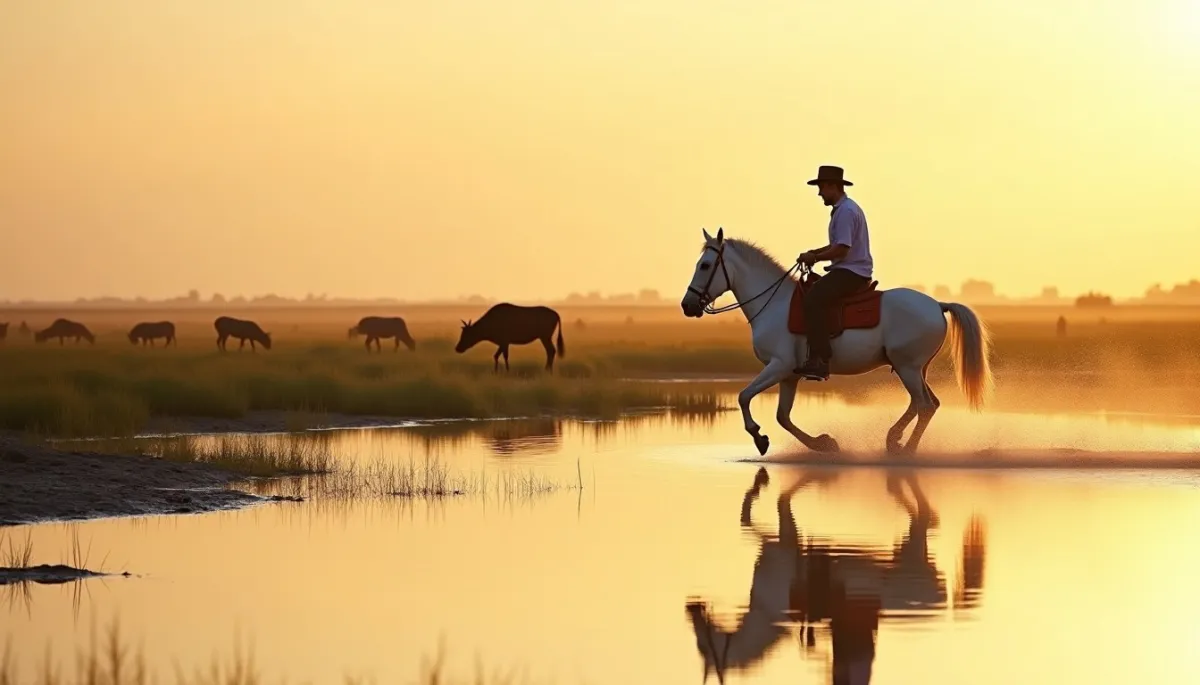
At sunset on a salt marsh, a small herd of Camargue horses moves with slow, economical gestures. Their white coats glow, tails flick like metronomes, and gardians watch from a distance, cigarette-smoke or smoke from a low peat fire drifting through the reeds to calm a swarm of insects. The landscape smells of brine and mallow; somewhere a trap hums softly. The scene looks unchanged, but beneath it lies a long negotiation between mammals and tiny, tenacious arthropods.
saltlands and swarms
In marshes and brackish lagoons, standing water and dense reedbeds create ideal breeding grounds for mosquitoes (family Culicidae) and for biting midges (genus Culicoides). These insects peak in warm months, especially from late spring to early autumn.
For horses, the nuisance is more than an annoyance. Repeated bites can trigger allergic reactions known as summer eczema or "sweet itch", a chronic condition caused by hypersensitivity to midge saliva. Affected animals scratch, rub and lose hair, sometimes from spring until autumn.
Historically, the Camargue's manades, the semi-feral herds managed by gardians, learned to live with this seasonal pressure. Rather than eliminating wetlands, they adjusted movements, grazing times and sheltering practices. That balance keeps both the traditional landscape and the horses healthy.
old practices, modern science
Gardians developed practical responses over generations. They graze horses later in the evening or in the middle of the day when certain insects are less active. They keep small smoky fires near camps to create a moving curtain of smoke that discourages mosquitoes without harming birds or flora.
Modern research confirms the logic. Many biting midges are crepuscular, most active at dawn and dusk. Limiting outdoor exposure at those hours reduces bite incidence. Simple barriers, like fine-mesh fly masks and rugs, significantly lower contact with insects.
Veterinary advances also offer options. For sweet itch, treatments range from protective rugs and stable management to topical soothing products and, in severe cases, immunotherapy prescribed by a veterinarian. Any chemical or herbal remedy should be discussed with a professional, because horse skin is sensitive and some products are photosensitizing or toxic.
contradictions in the marsh
Protecting horses while preserving wetlands is a delicate trade-off. Drainage would reduce mosquito breeding, but it would destroy habitats for birds like flamingos, and for the halophytic plants that define the Camargue. Conservation laws since the creation of the Parc naturel régional de Camargue in 1970 favor habitat protection.
Thus solutions are local and targeted. Blocking small pools around stables, using wind and fans to disrupt mosquito flight, installing nets and promoting biological traps reduce insect pressure without altering entire ecosystems. Integrated pest management is now preferred to broad, destructive interventions.
There are also social contradictions. Tourists expect pristine beaches and horse shows, yet the marshes that produce this image are insect-rich. Gardians reconcile this by scheduling events and daily work outside peak insect activity, by using subtle deterrents and by teaching visitors simple respect: keep calm, avoid perfumes that attract insects, and accept that the marsh has its own life.
practical advice
If you keep horses near marshes, start with the simplest measures: stable horses at dawn and dusk, remove stagnant water near paddocks, and deploy fine-mesh masks and sheets during peak months. Fans in stables are effective because many flying insects avoid moving air.
Consult a veterinarian for any persistent skin lesions. For suspected summer eczema, early diagnosis improves outcomes. Treatments combine environmental management, topical care and, when needed, more advanced veterinary therapies such as insect-proof rugs, antihistamines or targeted immunotherapy.
Finally, respect the landscape. The Camargue's identity is inseparable from its marshes and their insect life. Sustainable coexistence is possible when human care, animal behaviour and ecological protection are balanced. The gardians teach us that patience and observation often solve what brute force cannot.
In the low light, as horses toss their heads and the last mosquitoes recede, you sense a pact: the marsh gives food and freedom, the horses adapt and endure. That compact of life is what keeps the Camargue alive.